
How to Read Your Eyeglass Prescription: A Step-by-Step Guide
Just left the eye doctor with a prescription slip covered in weird abbreviations like OD, OS, SPH, and CYL? You’re not alone—it might as well be a secret code. But figuring this out is key, especially if you want to buy glasses online without messing up. This quick guide breaks down all those confusing terms in plain English, so you can get the right lenses easily.
Prescription Basics: OD vs. OS (Right Eye vs. Left Eye)
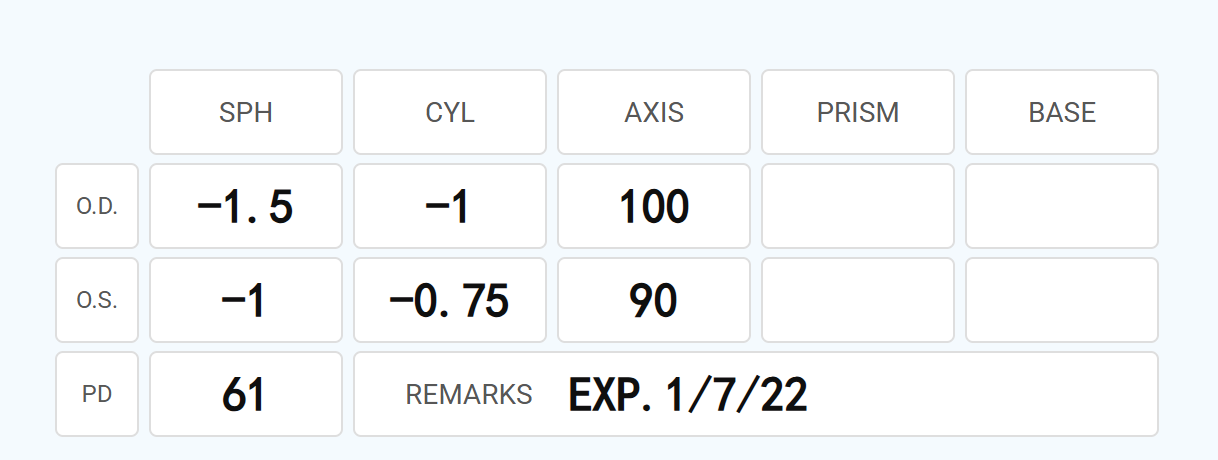
First things first: Let’s figure out which part is for which eye. Optometrists use old Latin abbreviations here, which is where most people get stuck.
OD (Oculus Dexter): Fancy Latin for "right eye." Everything under OD is for your right peeper.
OS (Oculus Sinister): That’s Latin for "left eye." Your left eye’s info is here.
Quick trick: "Dexter" means right-handed, so OD = right eye. "Sinister" used to just mean left (before it got its bad rep), so OS = left eye.
You might see OU (Oculus Uterque) too—that means "both eyes." But most doctors list each eye separately, so don’t stress if you don’t see it. Mixing up OD and OS is super common, so nail this first to avoid wrong lenses.
The Core Components: Key Parameters Explained
Now that you know which eye is which, let’s break down the numbers that actually matter for your lenses. These are what make your prescription unique to you.
SPH (Sphere) - For Nearsightedness and Farsightedness
SPH (Sphere) is the main number—it tells you how nearsighted or farsighted you are. It always has a + (plus) or - (minus) sign.
Minus (-): You’re nearsighted (can see up close but struggle with faraway stuff like road signs or whiteboards). The bigger the minus, the more nearsighted you are.
Plus (+): You’re farsighted (faraway things are clear, but reading or phone screens are fuzzy). A bigger plus means more farsightedness.
Example: OD: -2.00 SPH = Right eye is 2.00 diopters nearsighted. OS: +1.50 SPH = Left eye is 1.50 diopters farsighted.
CYL (Cylinder) & AXIS - For Astigmatism
If you see a CYL number, you have astigmatism—that’s just when your cornea is shaped more like an American football than a basketball (so light doesn’t focus right). It causes blurry or distorted vision, especially at night.
CYL (Cylinder): How strong your astigmatism is—this is the extra lens power needed to fix it. It can be + or -, depending on your doctor. If it’s blank or says "PL" (Plano), no astigmatism for you!
AXIS: Works with CYL to fix astigmatism—it’s the angle (1-180 degrees) where your cornea is most curved. 180 is horizontal, 90 is vertical. Super important—this tells the lab where to put the correction in your lenses.
Example: OD: -1.75 SPH / -0.50 CYL / AXIS 180 = Right eye: 1.75 nearsighted, 0.50 astigmatism fixed at 180 degrees (horizontal).
ADD (Addition) - For Multifocal Lenses
ADD (Addition) is for folks who need multifocal lenses—usually people over 40 who struggle to read up close (presbyopia). It’s the extra power needed for near tasks like reading or texting.
Key points about ADD values:
-
Always positive (usually +0.75 to +3.00).
-
Almost always the same for both eyes.
-
Used for progressives (smooth transition from far to near) or bifocals (line between far and near vision).
Example: ADD: +1.50 = Lenses get an extra 1.50 power for close-up stuff.
Extra Measurements That Matter
Your prescription might have other numbers—super important if you’re buying glasses online. They make sure your glasses fit and work right.
PD (Pupillary Distance)
PD (Pupillary Distance) is the distance between your pupils (in mm). This is huge for online orders—if it’s wrong, your lenses won’t line up with your eyes, causing headaches or blurriness, even with the right prescription.
How to measure PD:
-
Best way: Ask your eye doctor—they’ll do it for free at your exam.
-
At home: Stand 8-10 inches from a mirror, hold a ruler at your nose. Close one eye, line zero with your open pupil. Switch eyes, read the number. Do it twice, average.
-
Friend help: Have a buddy stand 2-3 feet away and measure—more accurate than doing it alone.
Prism
Prism is rare—it’s for when your eyes don’t work together (causes double vision or strain). It’ll have a number and direction (like BI = base in). Most people won’t see this.
Lens Recommendations
Doctors often suggest lens types based on your life:
-
Blue light filters: Great if you’re on screens all day—cuts eye strain and helps sleep.
-
Photochromic lenses: Darken in sun, lighten inside—no need for separate sunglasses.
-
High-index lenses: For strong prescriptions (over -3.00 or +3.00)—thinner and lighter than regular lenses.
-
Scratch-resistant coating: Must-have for plastic lenses (most common)—they scratch easy!
Sample Prescription Walkthrough
Let’s put this all together with a sample prescription—super easy to follow:
|
Eye
|
SPH
|
CYL
|
AXIS
|
ADD
|
PD
|
|---|---|---|---|---|---|
|
OD (Right)
|
-2.00
|
-0.75
|
170
|
+1.50
|
63 mm
|
|
OS (Left)
|
-1.75
|
-0.50
|
10
|
+1.50
|
-
|
Breakdown (simple version):
-
Right eye (OD): 2.00 nearsighted, 0.75 astigmatism (fixed at 170°), +1.50 for reading (multifocal).
-
Left eye (OS): 1.75 nearsighted, 0.50 astigmatism (fixed at 10°), +1.50 for reading.
-
PD: 63mm (distance between pupils).
Common Questions (You’re Probably Wondering)
Q: Can I use my glasses prescription for contacts?
A: Nope—they’re totally different! Contacts sit on your eye, glasses are 12-15mm away, so the power’s off. Contacts also need fit info (like base curve) that glasses don’t. Using glasses Rx for contacts is unsafe and illegal in most places.
Q: How long is my prescription good for?
A: Usually 1-2 years for adults in the US and Europe. Kids under 18 or people with diabetes? 6-12 months (vision changes faster). Always check the expiration—old Rx = wrong lenses.
Q: Can I use my old PD for new glasses?
A: Not recommended. Adults’ PD stays pretty steady, but it can shift a little (surgery, head injury, weight changes). Kids’ PD grows with them. Get a new measurement—doctors do it free!
Q: Why do new glasses feel weird even if the Rx is right?
A: New glasses usually take 1-2 weeks to get used to, especially progressives or new frames. If it’s longer than that: 1) Check your PD (misaligned = headaches). 2) Make sure frames fit—tight nose/ears cause pain. Call the store for a free adjustment!
Conclusion & Call-to-Action
Decoding your prescription isn’t rocket science. Once you know OD/OS (eyes), SPH/CYL/AXIS (vision issues), and PD (fit), you can buy glasses online confidently and get clear, comfy vision.
Now that you’re a prescription pro, time to find frames you love! We’ve got prescription sport sunglasses, goggles and everything in between—all with perfect Rx fitting. Stuck on PD or your Rx? Our team’s here 24/7 to help. Happy shopping!
Pro Tip: Replace your lenses every 1-2 years! Plastic lenses wear out, yellow, and scratch—even if your Rx hasn’t changed. We do lens replacements to make your favorite frames like new!