
![Diagram of [lens type] lens visual zones for ApexSpecs guide](https://img-va.myshopline.com/image/store/1760087174250/Eyeglass-Lenses-Guide-at-ApexSpecs-Photoroom-1280x719.jpg?w=1280&h=719)
Introduction: It's Not Just About the Frames
Let’s be honest—when picking new glasses, it’s easy to fixate on finding the perfect frame. Will it suit your style? Fit your face? But here’s the thing: lenses matter just as much, if not more. A stylish frame is useless if the lenses don’t let you see clearly. If you’ve stared at terms like “single vision,” “bifocal,” and “progressive” feeling confused, you’re not alone. At ApexSpecs, we believe an informed customer is a happy customer. This guide simplifies eyeglass lenses to help you choose confidently.
Single Vision Lenses: Clear Sight for One Distance
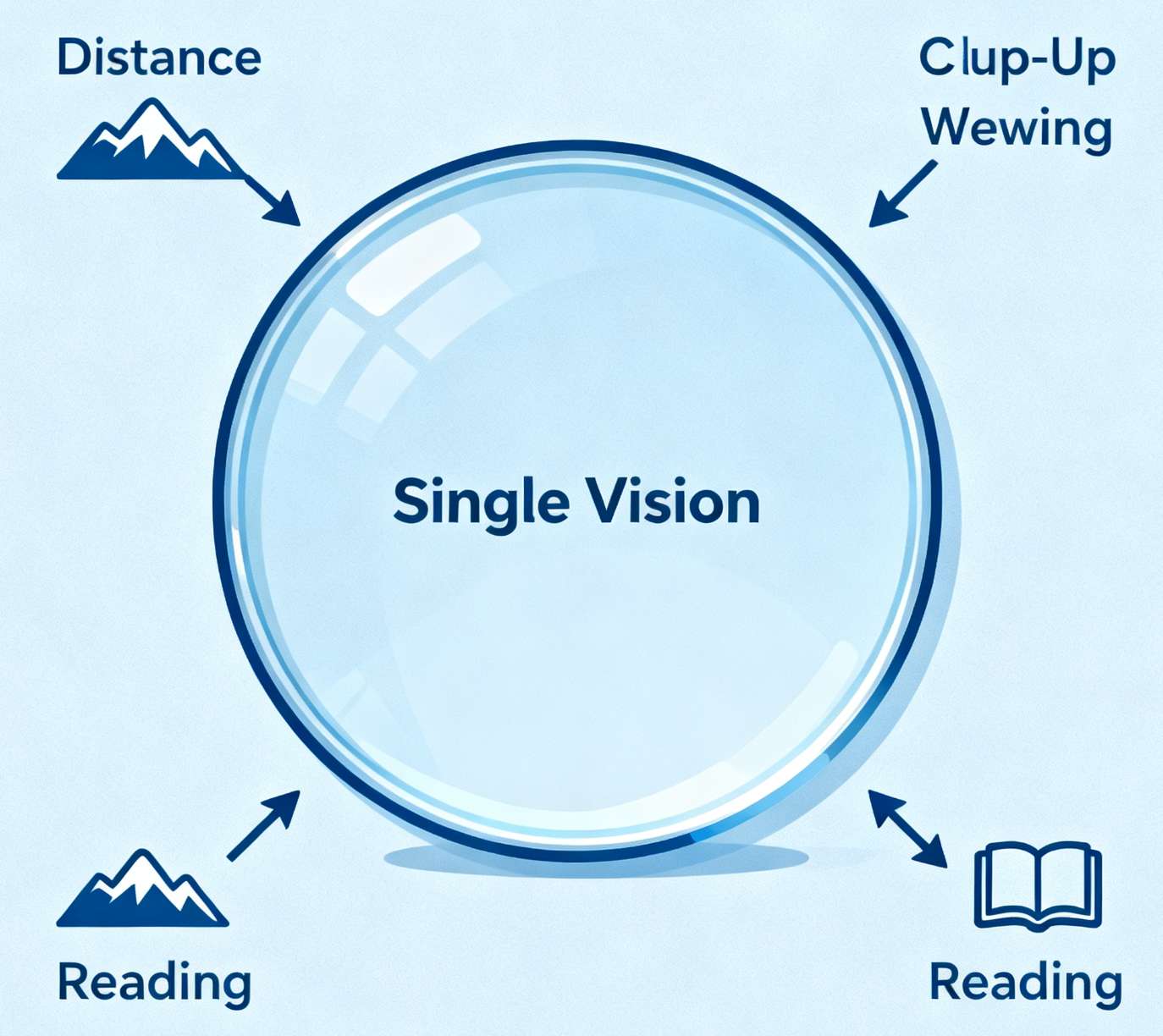
Start with the basics: single vision lenses have one uniform prescription across the entire surface. They correct one specific issue—nearsightedness (blurry distance), farsightedness (blurry close-up), or astigmatism (shape-related blurriness). Think of them as a tailored solution for one specific vision need. They’re typically the top pick for people under 40, whose eyes haven’t started changing and only need help with one type of vision—whether that’s a college student reading lecture slides or a driver squinting at road signs. Single vision lenses are our most popular option at ApexSpecs for customers with straightforward distance or reading prescriptions.
Multifocal Lenses: One Lens, Multiple Solutions
By your 40s, you might notice you’re holding menus at arm’s length to read them—even if you’ve never needed glasses before. That’s presbyopia: your eye’s natural lens loses flexibility, making close-up focus tough. And if you already need glasses for distance, switching between two pairs gets tedious quickly. Multifocal lenses solve this by combining multiple prescriptions in one lens.
-Photoroom-1280x853.jpg?w=1280&h=853)
Bifocal Lenses: The Classic Two-in-One
Bifocals are the classic multifocal choice—they’ve stood the test of time for good reason. A visible line divides the lens: top for distance (driving, TV), bottom for close-up (reading, texting). Bifocals shine for their simplicity and ease of adaptation—most people master switching between sections in a day or two, and they’re usually cheaper than other multifocals. But they have drawbacks: the visible line can be a style concern, there’s a “jump” when shifting focus, and no middle section—so computer screens (that in-between distance) often require tilting your head to see clearly.
Progressive Lenses (No-Line Bifocals): The Modern, Seamless Choice
Progressive lenses are the modern alternative to bifocals—often called “no-line bifocals” because they eliminate the visible divider. Prescription smoothly transitions from distance (top) to close-up (bottom), with a middle section for computers or cooking. They’re like three lenses in one, with no visible lines—total style win. The transition is natural too: no more jumping, just move your eyes up or down. They do require a short adaptation period (a day or two) to get used to moving your head instead of your eyes, and you might notice slight edge distortion initially. But at ApexSpecs, our high-quality progressive lenses maximize comfort and minimize distortion, making adaptation smooth.
Reading Glasses: For Close-Up Clarity
-Photoroom-960x1280.jpg?w=960&h=1280)
If your only issue is blurry close-up tasks, reading glasses are perfect. They’re a type of single vision lens with positive magnification for nearby objects. The best part? They’re flexible: get prescription pairs for specific needs or grab affordable over-the-counter ones at the drugstore for casual use. They’re ideal for anyone who doesn’t need glasses for distance (driving, TV) but squints at menus, books, or phones. Keep a pair handy—you’ll wonder how you managed without them.
Your Quick-Compare Guide: Lens Types at a Glance
|
Lens Type |
Best For |
Key Feature |
Ideal For |
|
Single Vision |
One viewing distance |
Single prescription across the entire lens |
People with nearsightedness or farsightedness only |
|
Bifocal |
Two distances (far & near) |
Visible line separating the two sections |
Those who need clear vision for distance and reading, but not for intermediate (computer) |
|
Progressive |
All distances (far, intermediate, near) |
No visible line, seamless transition |
Anyone with presbyopia wanting a natural, all-in-one vision solution |
|
Reading Glasses |
Close-up tasks only |
Magnifying lenses |
Occasional readers or those with a simple reading prescription |
Making Your Choice: Professional Advice is Key
Important Note: This guide is for informational purposes only. The best way to choose lenses is a comprehensive eye exam and consultation with an optometrist or ophthalmologist. They’ll assess your prescription, eye health, lifestyle, and habits to give personalized guidance. For complex prescriptions (like progressives), professional fitting is key for best results. At ApexSpecs, we craft high-quality glasses from your valid prescription—but we can’t replace an eye doctor’s expert diagnosis.
Conclusion: Find Your Perfect Lenses at ApexSpecs
By now, you have a clear overview of the main lens types: single vision for one distance, bifocals for two, progressives for all, and reading glasses for close-up tasks. No more confusion while shopping—you know exactly what to choose based on your vision and lifestyle. Ready to act? Explore ApexSpecs’ stylish, durable frames online. Upload your prescription, select your lens type, and we’ll craft your glasses with precision—giving you the clear, comfortable vision you deserve.
Need to measure your PD for a perfect fit? Check out our previous guide on How to Measure Your PD.